Neighbourhood Shops
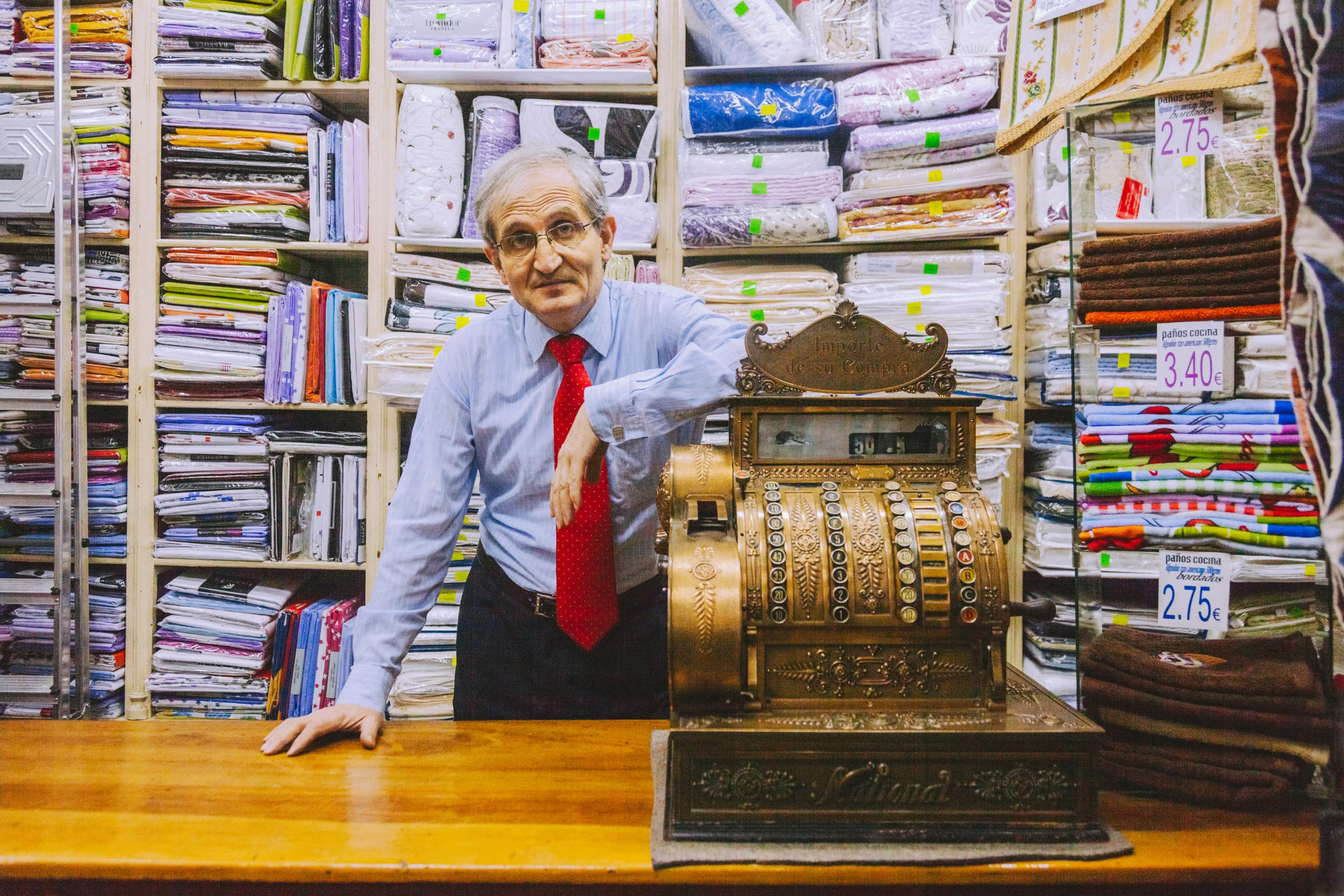
Antonio runs a household-fabric shop right in the centre of Madrid. Almacenes de Aragón, inherited from his father and grandfather, has stood on Corredera Baja de San Pablo since the beginning of the last century. The cash register I ask him to pose beside is as old and as vintage as the shop itself; he is now looking for a collector who will continue to care for it.
The flannel pyjamas in the window intrigued us enough to go inside. When I asked permission to take a few photographs of his century-old shop, the conversation caught fire. Antonio tells me that you can count on one hand the customers who enter on a Saturday afternoon, and that they are quite different from those who come on any other day. On a day off people enter with another disposition: calmer, more talkative, more inclined to say, sell me whatever you like. Perhaps Real Madrid sheets for the boy or a girdle for grandma. He sells more on Mondays, but then people come straight to the point because they already know what they want. Antonio has developed an entire theory of shopper psychology.
Antonio communicates remarkably well. In his neatly ironed shirt and tie he looks more at home in an office than behind a counter. He tells us that at thirty, partly for pleasure and partly to catch up academically with his wife and closest friends, he began studying law part-time. Slowly but surely, he applied himself so thoroughly that he eventually completed a doctoral thesis without ever leaving the family business.
Like everyone else, Antonio complains about the politicians in Congress. He hopes to retire in three years and two days; he counts down what remains as he once counted down military service. He speaks resignedly about the crisis while cutting fabric for a pair of made-to-measure pillowcases. Yet despite everything, he seems a fairly happy and fulfilled man.
His business has not only been hit by the ripple effects of the property crash that affected us all. Its real decline began in the mid-1990s, when hypermarkets spread throughout Spain and used their economies of scale against small retailers. That was the beginning of the disappearance of these familiar neighbourhood shops: experienced, intelligent and friendly shopkeepers with whom you could have a conversation. People who created social fabric and cohesion in the middle of commercial processes that are now as efficient as they are cold.